
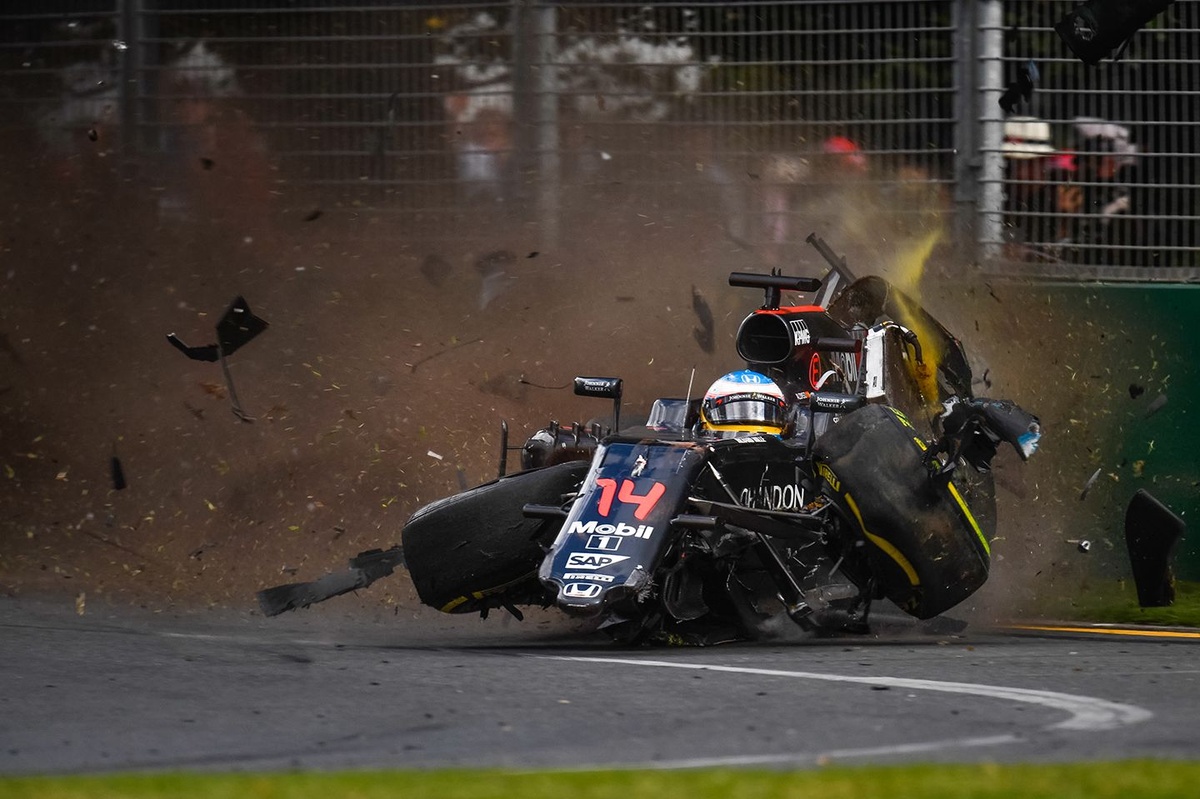

March 20, 2016, isn't just another date in Formula 1 history; it's a stark reminder of the sport's ever-present danger and its relentless pursuit of driver safety. The terrifying Fernando Alonso crash at the Australian Grand Prix that year sent shockwaves through the paddock, but ultimately became a catalyst for groundbreaking changes.
Key Takeaways:
- Fernando Alonso's terrifying 2016 Australian GP crash was a pivotal moment for F1 safety.
- The incident provided invaluable high-speed camera and G-force data, accelerating Halo development.
- FIA investigation revealed shocking impacts: 45G lateral, 46G roll, and multiple head impacts.
- Crucially, post-crash simulations demonstrated the Halo's viability, even allowing drivers to escape inverted cockpits.
The Melbourne Mayhem: A Near Catastrophe
It was Lap 17 of the 2016 Australian Grand Prix, a race where Fernando Alonso was battling in his underperforming McLaren-Honda. Attempting to overtake Esteban Gutierrez on the outside of Turn 3, disaster struck. The slightest contact with the Haas's rear wheel sent Alonso's car veering wildly.
Striking the outside wall, the McLaren became a destructive blur. It careened into the grass and gravel, digging into the earth before launching into a series of terrifying rolls. Miraculously, the car finally rested upside down near a tyre barrier.
The sight of Alonso emerging from the wreckage, seemingly unharmed, was a collective sigh of relief. Yet, subsequent medical checks revealed a pneumothorax and broken ribs, forcing him to miss the following Grand Prix. The incident served as a chilling wake-up call.
Anatomy of a Crash: The Raw Data Revealed
This harrowing crash occurred during a critical period for F1 safety – the ongoing debate about head protection. The Halo had already been tested, but skepticism remained. Alonso's tight escape from the mangled McLaren reignited questions, even providing ammunition for Halo critics.
However, the FIA didn't just react; they acted decisively. An unprecedented investigation leveraged new ultra-high-speed cameras, installed in F1 cars since 2015. This groundbreaking technology allowed for an unparalleled forensic analysis of the catastrophic event.
The data was staggering. Alonso's car hit Gutierrez at 313 km/h. The subsequent impact with the wall generated a 45G lateral deceleration, followed by a 46G impact during the roll. For almost a full second, the car was airborne. The high-speed footage chillingly showed Alonso's head striking his headrest twice.
The Halo Debate: A Turning Point for Safety
Laurent Mekies, then managing director of the FIA's research institute (now Team Principal at Red Bull), underscored the gravity of this data. "We want to understand the exact dynamics of the head, neck, and shoulders in a crash with high G-forces," he explained. The footage was instrumental in dissecting how the driver interacted with the cockpit, head protection, and HANS device.
This deep dive into Alonso's crash proved invaluable. It highlighted the precise forces exerted on the head and neck, revealing critical insights for designing the next generation of cockpits and refining safety protocols.
Simulations & Conviction: Proving the Halo's Worth
Beyond the immediate analysis, the FIA took their research a crucial step further. They meticulously simulated Alonso's accident with a Halo-equipped chassis. The results, unveiled in early 2017, were nothing short of game-changing, converting many of the Halo's staunchest opponents.
Mekies vividly recalled the experiment: "We flipped one of our chassis with a Halo. We put Andy Mellor [FIA technical consultant] inside to assess the worst-case scenario and asked him to get out, precisely in Fernando's position. Incredibly, he managed it."
This simulation proved that not only would the Halo have provided crucial protection in such an incident, but it also wouldn't hinder a driver's escape. It effectively dismantled a major philosophical barrier against its implementation.
Legacy of Protection: F1's Unwavering Commitment
The 2016 Australian Grand Prix crash wasn't just a horrific moment; it was the crucible that forged modern F1 safety. By winter 2018, the Halo was mandatory on all F1 cars, a testament to the sport's unwavering commitment to protecting its gladiators.
Since its introduction, the Halo's life-saving capabilities have been unequivocally proven, most notably in the harrowing crash of Romain Grosjean at the 2020 Bahrain Grand Prix. The debate is over; the Halo is a non-negotiable guardian, a direct legacy of Fernando Alonso's dramatic Melbourne scare.


