
The American Dream on the F1 Grid: Ranking the Top 5 US Teams
The roar of Formula 1 engines is louder than ever across the Atlantic, with Cadillac joining the grid and three US Grands Prix a testament to surging American interest. Yet, beyond the current fanfare, lies a rich, often overlooked history of homegrown talent battling on the global stage. While American motorsport boasts unparalleled strength, a consistent F1 presence has been rare. This is the definitive ranking of the top five American-led teams that dared to challenge Europe’s elite, leaving an indelible mark on F1's legacy.
Key Takeaways:
- US F1 Resurgence: Cadillac and Haas F1 Team represent a new era of American involvement, alongside three US Grand Prix events.
- Historical Impact: Few American F1 teams have achieved longevity, but those that did left a significant mark, often with legendary drivers at the helm.
- Triumphs & Tragedies: The journey for these pioneering teams was fraught with challenges, featuring both groundbreaking victories and heartbreaking losses.
- Engineering Prowess: From bespoke engines like Weslake's V12 to strategic partnerships with Ferrari, American teams showcased diverse approaches to F1 car development.
5. Parnelli: The Indycar Dream Goes Global
Years: 1974-76
Starts: 16
Best Finish: 4th
Points: 6
Born from the legendary Parnelli Jones's dominant Indycar empire, the Vel's Parnelli Jones Racing outfit ventured into Formula 1 with high hopes. Armed with ex-Lotus design maestro Maurice Philippe and the electrifying talent of Mario Andretti, the stage was set for an American assault on F1.
Their Cosworth DFV-powered VPJ4 debuted at the 1974 Canadian GP. While Andretti consistently pushed the limits, securing vital points in 1975 races like Sweden and France, the team's promising run was cut short. A critical lack of Firestone sponsorship ultimately forced their premature withdrawal in 1976, despite Andretti's strong 6th place finish at the South African GP.
4. Haas F1 Team: America's Modern Stalwart
Years: 2016-present
Starts: 214+ (ahead of 2026 season)
Best Finish: 4th
Points: 386
Gene Haas successfully planted the American flag firmly in the F1 paddock, establishing the most successful new team in decades. From its Kannapolis, North Carolina headquarters, Haas defied expectations by scoring points in its debut 2016 Australian GP and achieving a remarkable 5th in the 2018 Constructors' Championship.
Leveraging a unique partnership with Ferrari for engines and Dallara for chassis, Haas has provided a platform for drivers like Romain Grosjean, Kevin Magnussen, Mick Schumacher, and Nico Hulkenberg. Memorable moments include a stunning 4-5 finish at the 2018 Austrian GP. Despite a challenging 2021 season, Magnussen's return in 2022 brought a morale-boosting 5th in Bahrain. The team continues to evolve under new leadership, with Ayao Komatsu at the helm and a fresh driver lineup featuring Oliver Bearman and Esteban Ocon for 2025, solidifying its place as a enduring American presence.
3. Penske: Roger's Brief, Brilliant F1 Foray
Years: 1971, 1974-76
Starts: 32
Wins: 1
Podiums: 4
Poles: 1
Points: 26
Roger Penske, a titan of American motorsport, brought his winning pedigree to F1 for a short but impactful period. After an initial toe-dip running McLarens in 1971, where Mark Donohue impressed with a 3rd at Mosport, Penske launched his own chassis, the PC1, in 1974.
The team's journey was marked by both promise and profound sadness. Donohue scored points in 1975 but tragically suffered fatal injuries at the Osterreichring. Yet, from this tragedy rose triumph. With John Watson behind the wheel of the improved PC4, Penske achieved its sole F1 victory at the 1976 Austrian GP, a poignant win at the same circuit where Donohue had fallen. This historic win, where Watson famously shaved his beard, cemented Penske's place in F1 lore before the team shifted its focus back to dominating Indycar.
2. Shadow: Dark Horses with Flashes of Brilliance
Years: 1973-80
Starts: 104
Wins: 1
Podiums: 7
Poles: 3
Points: 67.5
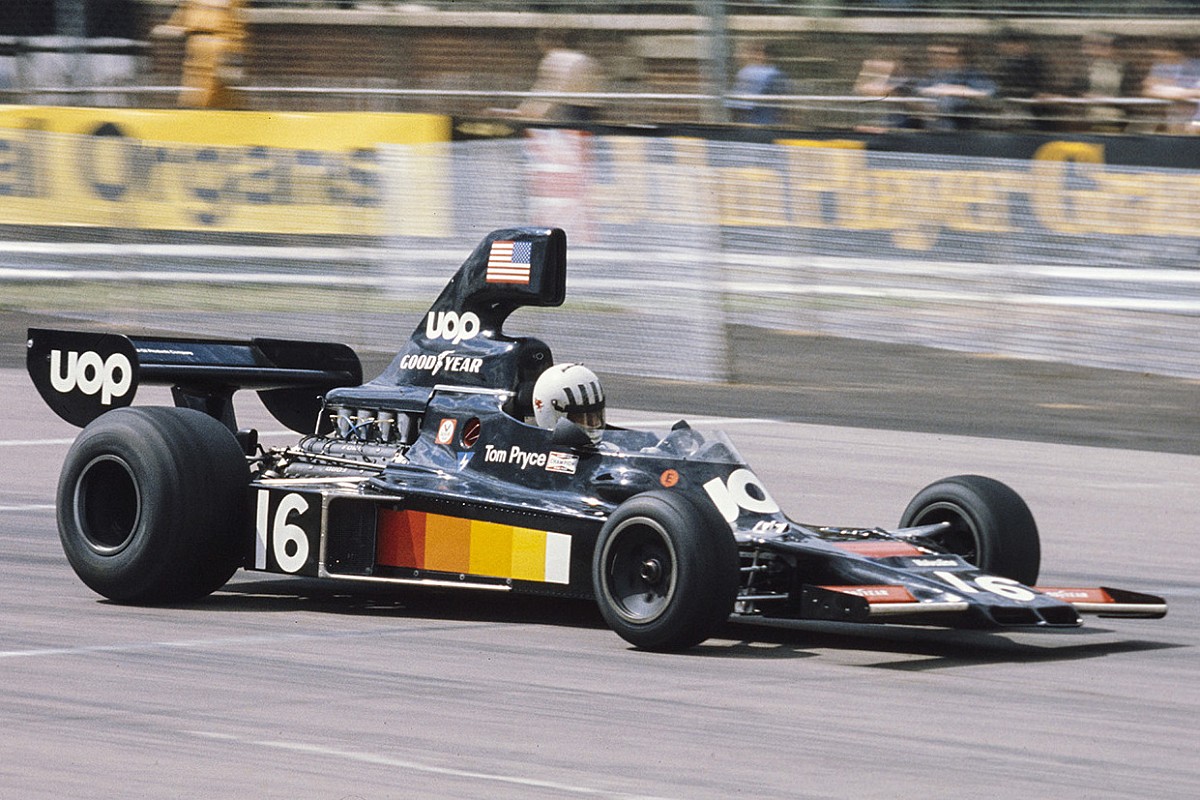
Don Nichols' Shadow team initially emerged as a distinctively American outfit, though it later raced under a British license. Known for its striking, often sinister-looking cars, Shadow proved it had speed to match its style. George Follmer scored an early podium at the 1973 Spanish GP in the sleek DN1, while Jean-Pierre Jarier famously took pole positions and led the 1975 Brazilian GP in the dominant DN5 before mechanical issues intervened.
Despite repeated flashes of pace and a non-championship win for Tom Pryce at the Race of Champions, true F1 victory eluded Shadow for years. That changed at the 1977 Austrian GP, where Alan Jones navigated treacherous wet conditions in his DN8 to claim the team's first, and only, F1 World Championship win. The team, however, was also tragically touched by the deaths of drivers Peter Revson and Tom Pryce. Internal strife and the loss of personnel to the new Arrows team eventually led to its decline, but Shadow's bold designs and occasional brilliance ensure its legacy endures.
1. Eagle: Dan Gurney's American Masterpiece
Years: 1966-68
Starts: 27
Wins: 1
Podiums: 2
Best Qualifying: 2nd
Points: 17
No American F1 team captures the imagination quite like Dan Gurney's Anglo American Racers (AAR), and its stunning Eagle chassis. Often hailed as one of the most beautiful racing cars ever created, the T1G was more than just a looker; it was a groundbreaking machine, powered by a bespoke Weslake V12 engine – a rarity in an era dominated by customer engines. Gurney, one of America's all-time great drivers, established the team in the UK, aiming for nothing less than F1 glory.
The Eagle made its debut in 1966, and by 1967, it was a serious contender. Gurney secured an emotional victory at the 1967 Belgian GP, driving his own car, with his own engine, an almost unheard-of feat. He frequently challenged the formidable Lotus 49 with its new Cosworth DFV engine, despite the Weslake V12's persistent reliability issues. Though financial constraints ultimately led to the team's F1 withdrawal after 1968, Gurney's Eagle proved that an American vision, backed by innovative engineering and fierce talent, could soar among F1's giants. The Eagle legacy continued in Indycar and IMSA, but its F1 chapter remains a defining moment for American motorsport.