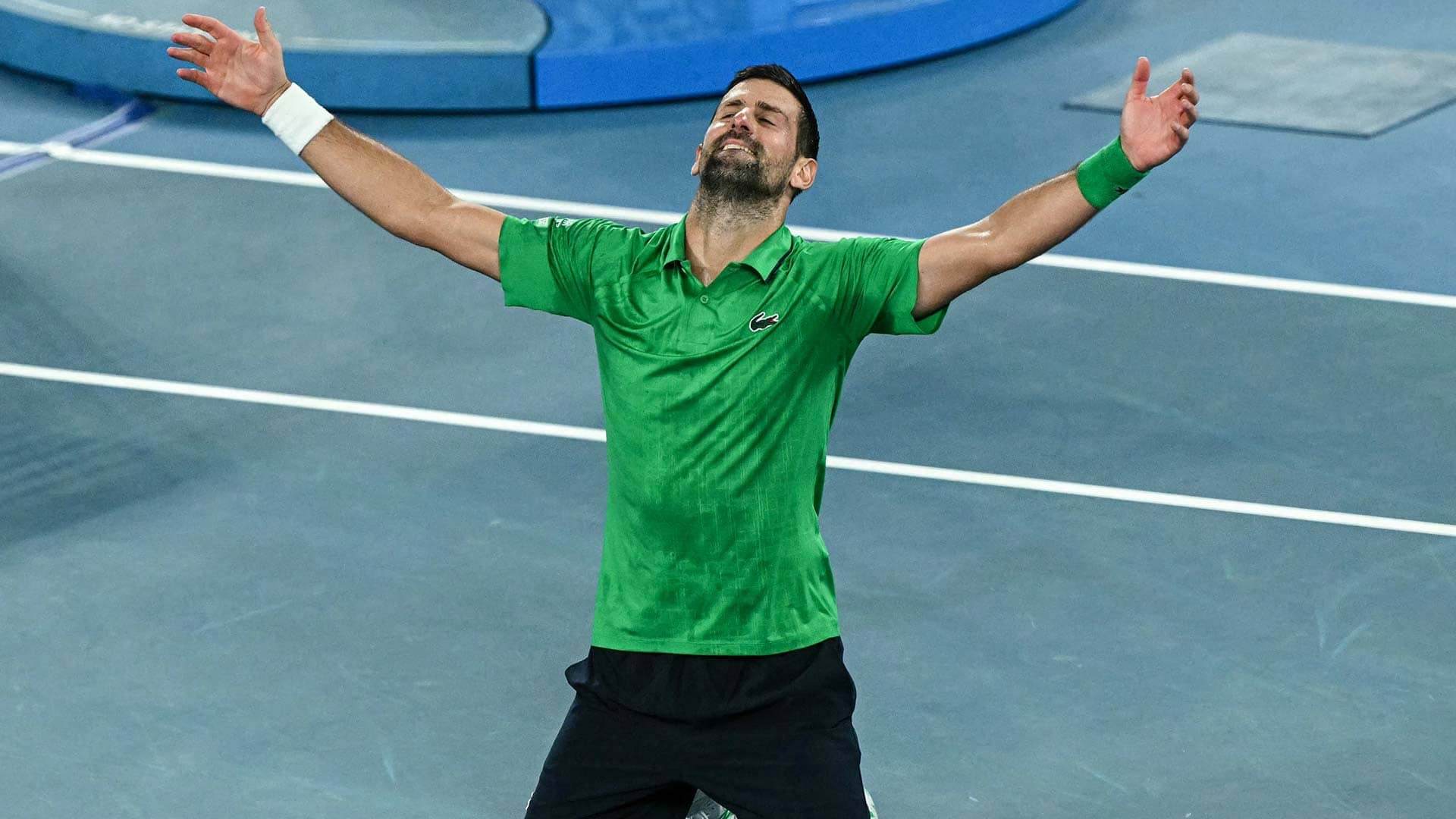

Novak Djokovic delivered another historic Australian Open campaign in 2026, breaking multiple records and reinforcing his status as one of the greatest players in tennis history, despite narrowly missing out on the title.
The Serbian star began his tournament by reaching a major milestone with his 100th career win at the Australian Open, achieved in the opening round against Pedro Martinez. He became only the second player after Roger Federer to reach that mark in Melbourne. More significantly, Djokovic became the first player in history to record 100 or more wins at three different Grand Slam tournaments, having already achieved the feat at Roland Garros and Wimbledon.
That victory also extended his streak of first-round wins at Grand Slams to 76, an Open Era record stretching back two decades. He continued his early-round dominance in the second round, improving his run to 64 consecutive wins in the first two rounds of majors. Djokovic also maintained a perfect 32-0 record against qualifiers at Grand Slam events.
In the third round, Djokovic reached another landmark by recording his 400th career Grand Slam match victory with a win over Botic van de Zandschulp. He became the first player in history, male or female, to reach that figure. The same result saw him make his 70th appearance in the round of 16 at a major, surpassing Federer’s Open Era record.
A walkover later in the tournament sent Djokovic into his 16th Australian Open quarterfinal, the most by any male player, and his 65th Grand Slam quarterfinal overall, further extending his own record.
One of the defining moments of his campaign came in the semifinals, where he defeated Jannik Sinner in a five-set match. The victory ended Sinner’s 19-match winning streak at the Australian Open and halted several other impressive runs by the Italian. Djokovic also prevented a fourth consecutive Grand Slam final between Sinner and Carlos Alcaraz.
The win ensured that Djokovic remains the only player in the Open Era to complete two Australian Open hat-tricks, achieved between 2011 and 2013 and again from 2019 to 2021. It was also his 20th victory over a Top 5 opponent in Melbourne, equalling Rafael Nadal’s record at Roland Garros. With that result, he moved clear of Federer’s Australian Open win tally, reaching 104 victories at the tournament.
Djokovic’s semifinal success carried him into his 11th Australian Open final, the most by any man, and his 38th Grand Slam final overall, an all-time record. At 38, he became the oldest men’s finalist at the tournament in the Open Era and the oldest to reach any major final since Ken Rosewall in 1974.
The run also marked the 17th different season in which Djokovic has reached at least one Grand Slam final, highlighting his exceptional longevity. He has now contested 38 finals from 81 major appearances, underlining his remarkable consistency at the highest level.
Following the tournament, Djokovic returned to the Top 3 of the ATP rankings and extended his record of weeks inside the elite group to 757, equivalent to more than 14 years among the world’s best players.
While the championship trophy ultimately eluded him, Djokovic’s Melbourne campaign once again demonstrated his enduring excellence and ability to redefine the limits of longevity in modern tennis.