
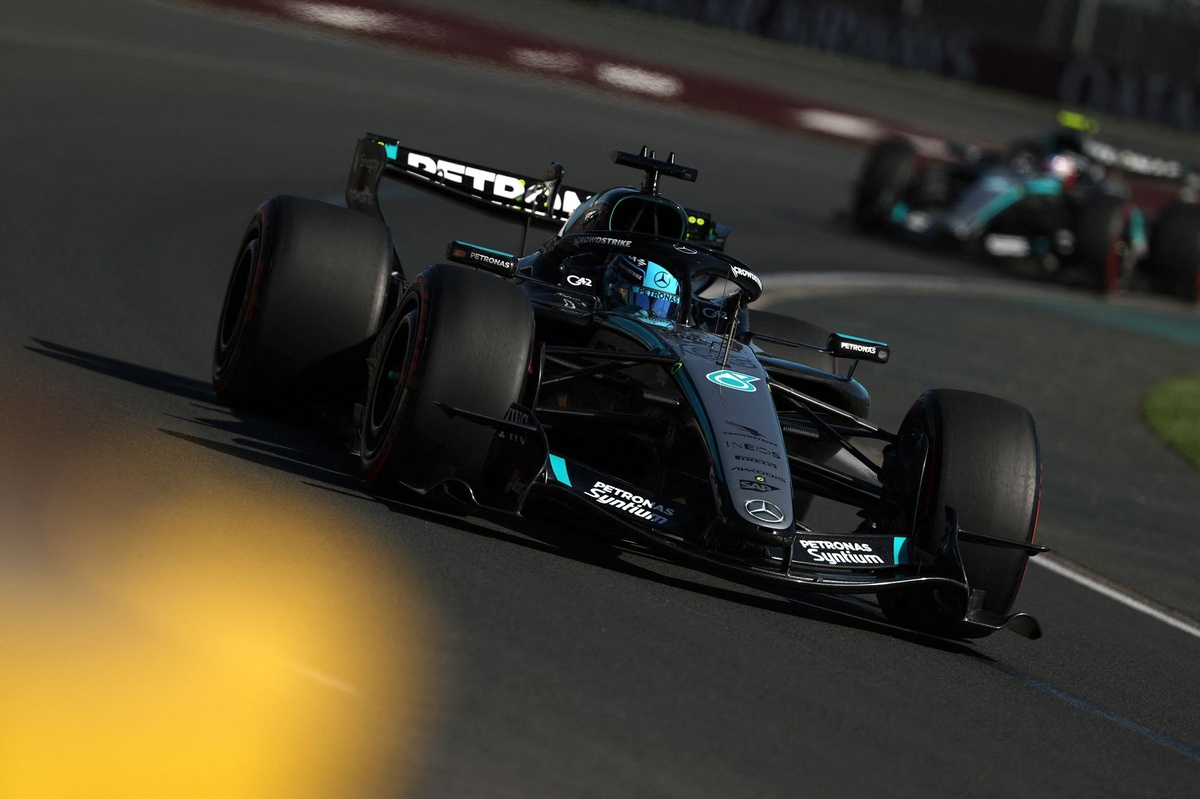

The Melbourne Mirage: Why Single-Lap Glory Was Deceptive
Friday practice sessions at the Australian Grand Prix initially painted a picture of fierce competition. Ferrari dominated FP1, then McLaren's Oscar Piastri set the quickest lap in FP2. This suggested a thrilling four-way fight for pole and victory.
However, these single-lap heroics might be a smokescreen. The real story unfolded during the long runs at the end of FP2, where Mercedes truly shined. With heavy fuel loads, the W17's race pace appears formidable, hinting at strategic sandbagging from the German squad.
Mercedes Unleashed: Unpacking the W17's Race Potential
When it came to sustained performance, Mercedes was in a league of its own. George Russell topped the long-run charts, demonstrating pace that left rivals scrambling. He was a massive 0.48 seconds per lap quicker than his Mercedes teammate Lewis Hamilton and a staggering 0.6s ahead of Ferrari's Charles Leclerc on comparable runs.
This wasn't a one-off. Even in FP1's shorter long runs, the Silver Arrows showed clear superiority over both Red Bull and Ferrari under heavy fuel. The Mercedes performance here is a stark contrast to their single-lap times, raising eyebrows across the paddock.
The Engine Mode Enigma: A Masterclass in Sandbagging?
The discrepancy between single-lap speed and long-run dominance can largely be attributed to engine modes. Data analysis reveals that Mercedes likely operated with significantly less engine power during their qualifying simulations.
In the second sector of Albert Park, where cars hit their highest speeds, both Mercedes drivers managed a mere 279 km/h. In stark contrast, Oscar Piastri, running a customer Mercedes engine, hit 289 km/h on his fastest lap. This "super-clipping"—a stronger drop-off in top speed—strongly indicates Mercedes kept significant power in reserve.
Across all speed traps, Mercedes consistently ranked lower. At the start-finish straight, Russell hit 294 km/h, while Piastri's McLaren clocked 300 km/h. This consistent underperformance in raw speed suggests a calculated strategy to conserve energy and mask their true single-lap potential.
Rivals on the Ropes: Red Bull, Ferrari & McLaren's Race Pace Puzzle
While Mercedes played coy, their rivals faced their own challenges during long runs.
Red Bull's Race Pace Headaches
Despite their championship pedigree, Red Bull lagged significantly, showing an extrapolated deficit of 0.8s per lap to Mercedes in long runs. Crucially, they achieved this slower pace on the softer, supposedly faster C4 medium tyres, compared to Mercedes' harder C3 compound. Energy deployment seemed to be an issue, with a Red Bull driver hitting only 250 km/h in the first sector speed trap, indicating energy might have been spent too early.
McLaren's Deceptive Glory
Oscar Piastri's fastest time in FP2 was impressive, but McLaren's long-run pace was a disappointment. The Australian finished with a tyre-adjusted deficit of 1.27 seconds per lap to Mercedes. It appears McLaren pushed their engine harder over a single lap, revealing more of the Mercedes power unit's potential than the factory team itself.
Ferrari's Battery Management Balancing Act
Ferrari also demonstrated inconsistent energy deployment. Charles Leclerc managed only 294 km/h before Turn 1, significantly slower than Lando Norris' 309 km/h. However, Ferrari was strong at the finish line, with Leclerc reaching 308 km/h. These variations suggest teams are still grappling with optimal battery management for the unique demands of **Albert Park**.
Midfield Movers & Tyre Strategy Unveiled
Beyond the top teams, the midfield also offered intriguing insights. **Audi's Nico Hulkenberg** impressed with the fastest midfield long run, averaging just 1.95 seconds behind **George Russell**. Meanwhile, **Racing Bulls' Arvid Lindblad** showed single-lap promise but struggled on long runs.
Tyres are unlikely to be a major variable. Wear was minimal across all compounds during long runs, suggesting a straightforward **one-stop strategy** for the race. Pirelli chief engineer Simone Berra noted that "none of the options appears to be particularly disadvantaged, meaning all three compounds could come into play." This confirms that driver management and raw pace, not tyre degradation, will define the race.