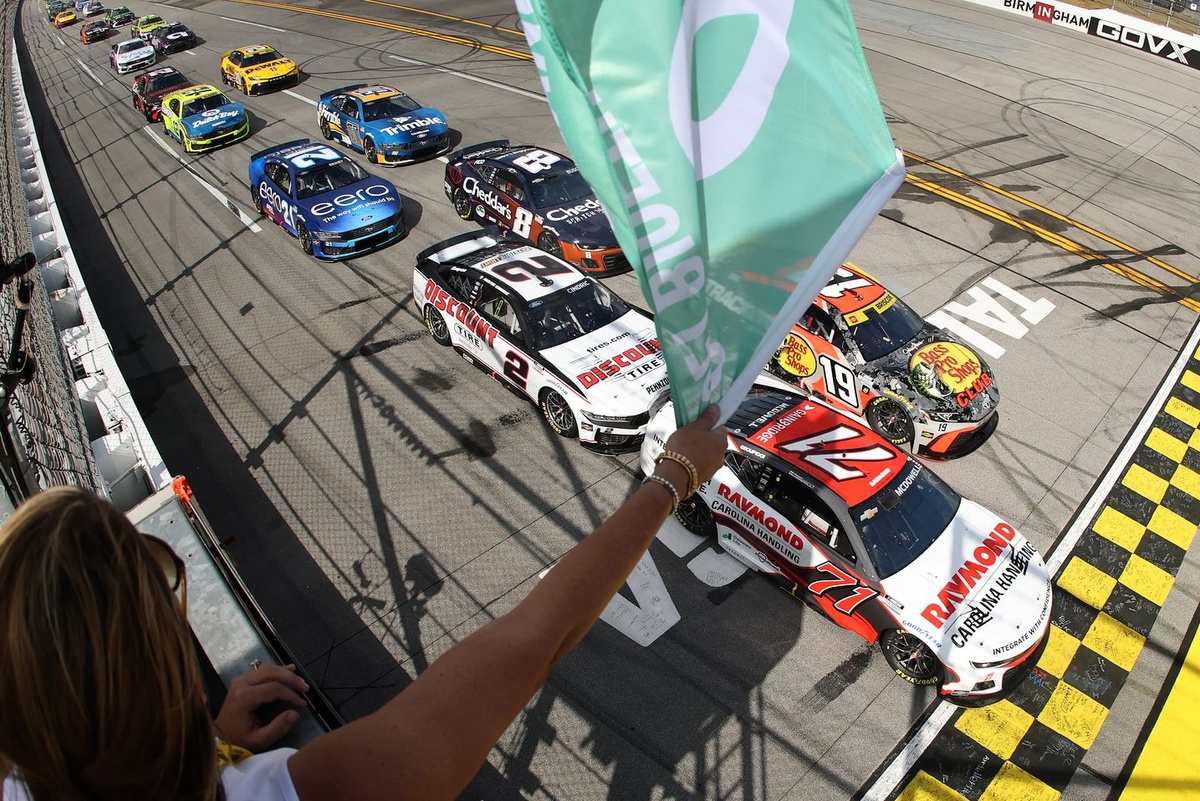

A massive NASCAR Rule Book update was posted on Friday and removes every instance of ‘the playoffs’ and ‘playoff points’ to reflect the return of the Chase for the Championship format this season.
Essentially, this codifies the new regulations with NASCAR also making several adjacent adjustments alongside other items that needed addressing after consideration over the winter.
The Chase for the Championship has been officially codified into the NASCAR Cup Series Rule Book today pic.twitter.com/yT4vZWIgDm
Another rule change drastically changes the fortunes of a driver who gets suspended for behavioral reasons. For example, last year, Austin Hill was suspended for a single race in response to a retaliatory right rear hook on Aric Almirola and lost all of his playoff points.
It turned what appeared like a final four caliber season into one where he was unable to advance past the second round. Now, a suspension just means that driver just doesn’t accumulate points for a race, which has consequence on its own merit, but is no longer a de facto championship death sentence.
If a waiver is granted for reasons other than a NASCAR-initiated and/or approved absence, the driver will begin with Championship Event 27 with 2000 points. NASCAR’s waiver determination, including any reseeding decision, is final and non-appealable.
A NASCAR communications representative detailed what that meant in an email disseminated on Friday afternoon to media members.
“For example, a NASCAR-initiated absence could include a one-race suspension. Previously, a driver would start the postseason with 2000 points. With the change in format and elimination rounds no longer a part of the format, a suspended driver would no longer drop to 2000 points.”
Those drivers would simply be reseeded to wherever they finished in the regular season.
Remember that last year, Kyle Larson and crew chief Cliff Daniels became kind of masters of taking advantage of a bad day in that they would take their damaged car after a crash and inflate their tires in the pursuit of an easy fastest lap of the race.
Since that now pays a single point in each race, it was a way for teams with crashed cars to take advantage of their misfortune, but also deny a still competitive team the chance to race for that bonus.
NASCAR has now closed that loophole. Any team that has their car land on the damaged vehicle policy is no longer eligible for the fastest lap bonus point in that race.
For 2026, NASCAR has added up to four additional starting grid positions for a new OEM vehicle over the first three events. This is for RAM, which debuts in 2026 with five trucks running under the Kaulig Racing banner, giving those entrants a chance to score owner points to otherwise become locked-in for the remainder of the campaign.
NASCAR notes that ‘new OEM vehicles will be assigned starting grid positions 37th-40th based on the speeds posted in the first Qualifying round.’
If those trucks need to use those provisionals for these first three races, they will not earn prize money, but will gain the points and the rest of the season will play out naturally starting in the fourth race.
A previously written and posted rule now allows Cup drivers with over three years of experience at the highest level to participate in up to 10 races in the O’Reilly Auto Parts Series and up to 8 in the Craftsman Truck Series.
This is up from five in previous seasons.
The update now states that any driver accumulating points in the Cup Series will not be permitted to enter Chase for the Championship races in the O’Reilly and Craftsman Truck divisions.
Previously, the ban extended to the regular season finale, but that is no longer the case. This reflects the abolishment of the win and you’re in system used under the playoff format.
From a NASCAR representative in the aforementioned email explainer:
“At tracks 1.25 miles and shorter and all road courses, the minimum age drops to 17 (from 18). This is similar to the rule in the NASCAR Craftsman Truck Series, were the minimum age is 16 at tracks under 1.25 miles and road courses.”

In the Truck Series, this is how penalties will be applied for loose lug nuts:
20 safe and secure | No penalty
19 safe and secure | Loss of pit selection next week
18 safe and secure | $2500 fine, crew member suspended one race
17 safe and secure | $5000 fine, two crew members suspended one race
16 safe and secure | disqualification
In the O'Reilly Series, this is how penalties will be applied for loose lug nuts:
20 safe and secure | No penalty
19 safe and secure | Loss of pit selection next week
18 safe and secure | $5000 fine, crew member suspended one race
17 safe and secure | $10000 fine, two crew members suspended one race
16 safe and secure | disqualification
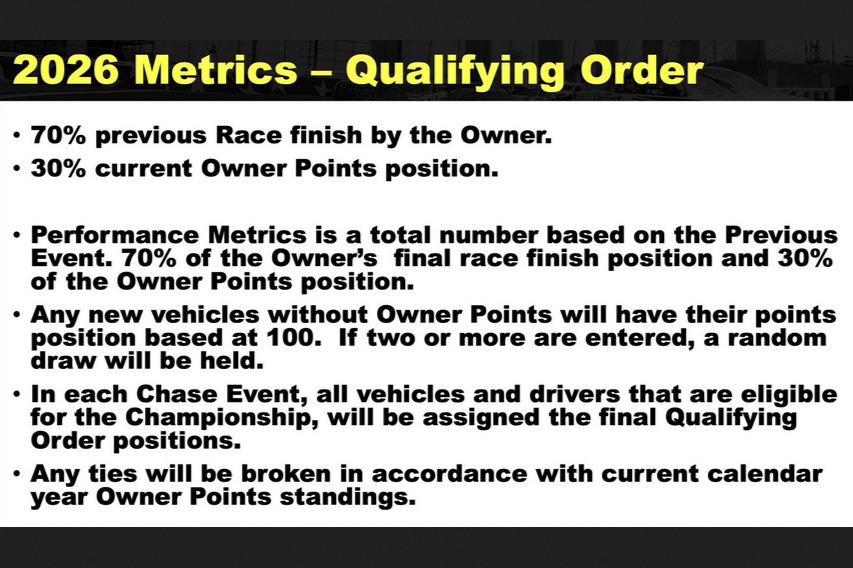
This is how qualifying order is determined each week.
March 16: Vegas
April 21-22: Chicagoland
May 12-13: Iowa
June 2-3: Indianapolis
There was an organizational test earlier in the week at North Wilkesboro but no more such tests are currently on the docket.
The following rules will be applied to drivers required to attend a test after recovering from an injury to determine approval
I. Spectators will not be permitted
J. The associated team must submit documentation from the driver's physician requesting an on-track evaluation, at least three days before the scheduled test.
K. Rosters and roster limits may be implemented as deemed necessary by NASCAR
L. NASCAR will determined the tires to be used for the test
M. Teams will not be permitted to use data systems, set-up equipment , and scales at the test
N. Teams will not be permitted to use a track photographer
O. NASCAR will determine the duration of the test
Stimulants include, without limitation:
Amphetamine, Methamphetamine, Ecstasy (MDMA), Eve (MDEA), MDA, PMA, Phentermine, and other amphetamine derivatives and related compounds.
Narcotic Analgesics include, without limitation:
Alfentanil, Fentanyl, Hydromorphone, Marijuana (Cannabis)/ Tetrahydrocannabinol (THC), Meperidine, Methadone, Morphine, Oxycodone, Oxymorphone, Propoxyphene, Sufentanil, Heroin and /or their chemical and pharmacological analogs and related compounds, Codeine, Dihydrocodeine, Hydrocodone and Codeine analogs and related compounds (including those available over the counter in some countries if taken for non-medical use.
Ephedrine Class includes, without limitation:
Ephedrine, Pseudoephedrine, Phenylpropanolamine and/or their chemical and pharmacological analogs and related compounds (even if purchased as an over-the-counter medication without a prescription if used in a manner inconsistent with the instructions provided by the manufacturer).
Benzodiazepines include, without limitation:
Alprazolam, Diazepam, Lorazepam (Ativan), Oxazepam (Serax), Temazepam (Restoril), Alpha-hydroxy-alprazolam (Xanax), Nordiazepam (Valium) and/or chemical and pharmacological analogs and related compounds.
Barbiturates include, without limitation:
Amobarbital (Amytal), Butalbital (Anolor 300, Esgic, Fioricet, Fiorinal), Butabarbital (Butisol), Phenobarbital (Luminol, Solfoton), Pentobarbital (Nembutal, Nembutal Sodium), Secobarbital (Seconal) and/or chemical and pharmacological analogs and related compounds.
Performance-Enhancing Drugs includes, without limitation:
Anabolic androgenic steroids (AAS), Clenbuterol, Human Growth Hormone (hGH), Human Chorionic Gonadotropin (hCG), Luetenizing Hormone (LH), Insulin-like Growth Factor (IGF-1) as well as: 4-Chlortestosterone, Androstenediol, Androstendione, Bolasterone, Boldenone, Chloroxomesterone (dehydrochlormethyltestosterone), Clostebol, Dihydroepiandosterone, Dihydrotestosterone, Depitestosterone, Dromostanolone, Epitestosterone, Fluoxymesterone, Formebolone, Furazabol, Mesterolone, Methandienone (Methadrostenolone), Methandriol, Methenolone, Methylclostebol, Methyltestosterone, Methyltrienolone, Mibolerone, Nandrolone, Norandrostendione, Norethandrolone, Norethindrone, Oxabolone, Oxandrolone, Oxymesterone, Oxymetholone, Stanozolol, Stenbolone, Testosterone, Trenbolone, growth hormone-releasing hormone (GHRH) and its analogues (e.g., CJC-1293, CJC-1295, sermorelin and tesamorelin), growth hormone secretagogues (GHS) and their mimetics (e.g., anamorelin, capromorelin, ibutamoren (MK-677), ipamorelin, lenomorelin (ghrelin), macimorelin and tabimorelin), GH-releasing peptides (GHRPs) (e.g., alexamorelin, examorelin (hexarelin), GHRP-1, GHRP-2 (pralmorelin), GHRP-3, GHRP-4, GHRP-5 and GHRP-6).
Muscle Relaxers include, without limitation:
Carisoprodol (Soma), Meprobamate (Miltown, Meprospan).
Sleep Aids include, without limitation:
Zolpidem (Ambien).
Beta Blockers include, without limitation:
Acebutolol, Alprenolol, Amosulalol, Atenolol, Betaxolol, Bisoprolol, Carteolol, Esmolol, Landiolol, Levobunolol, Mepindolol, Metipranolol, Metoprolol, Nadolol, Nebivolol, Oxprenolol, Penbutolol, Pindolol, Propranolol, Sotalol, Tilisolol, Timolol).
Hormone and Metabolic Modulators include, without limitation:
Anastrozole, Arimidex, Aromatase inhibitors (Androst-3, 5-dien, 17-dione), ATD, Clomid, Clomiphene, Evista, Formestane, Fulvestrant, SARMS, “SERMS” (Raloxifene, Tamoxifen (Nolvadex), Toremifene).
Other Prohibited Substances:
Any use of the following is strictly prohibited under this Policy:
Cup Series
O'Reilly Series

Truck Series
What would you like to see on Motorsport.com?
- The Motorsport.com Team