
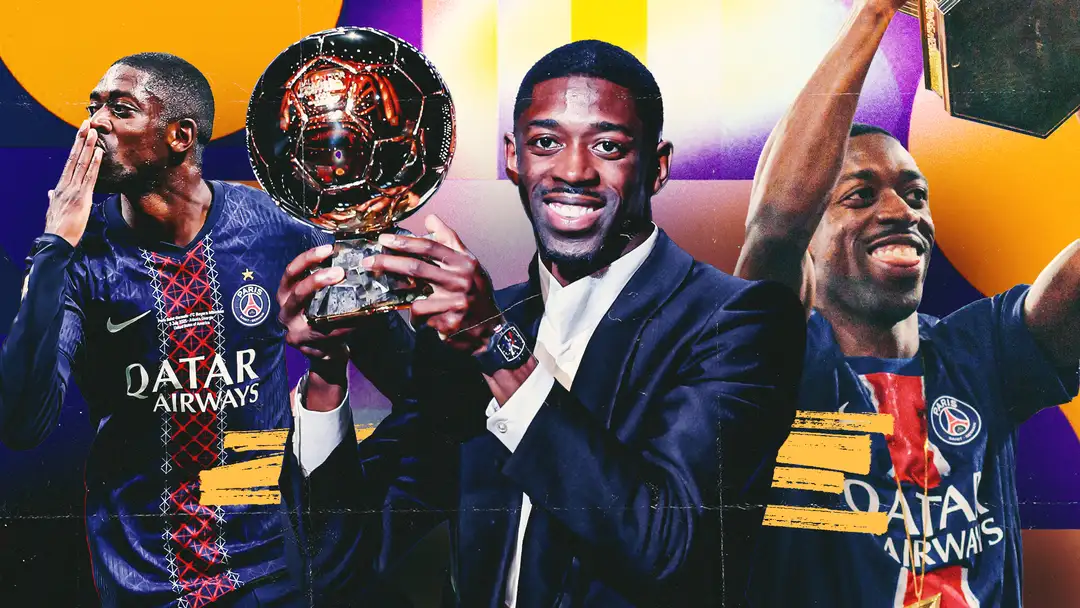

PSG are the unquestionable kings of Europe, winning the European Cup in any format for the first time in their history - a significant feat not just for a team only founded in 1970, but one for the Qatari Sports Investment (QSI) project which has been hell-bent on continental domination since their takeover in 2011.
Luis Enrique's side will be remembered for years to come for their tiki taka-lite style based on fluidity and slick possession football, and at the forefront of their success has been Dembele.
With the Ballon d'Or now judged on a seasonal basis - as should have always been the case, thank you, France Football - it is a campaign that has logically concluded with Dembele lifting the prestigious Golden Ball in his homeland.
The wasted years at Barcelona
Dembele's career has been a tale full of dizzying highs and disappointing lows. It seemed destined to play out that way from the very start. After all, he became the second-most expensive footballer of all time less than two years after making his senior debut, and it's not as if he had a standout reputation during his days as a youth player.
After impressing in France's fifth tier with Rennes' B team, Dembele was promoted into the first-team fold for the 2015-16 season, though had to wait until November to make his debut. He ended that campaign with 12 goals and five assists in only 26 Ligue 1 appearances, averaging 0.8 contributions per 90 minutes. Albeit the sample size was small, it was still enough to convince Borussia Dortmund to spend €35 million on him in the summer of 2016, and after one further fantastic season at Signal-Iduna Park, Barcelona forked out a staggering €135m to sign him.
Such a step arguably came too soon for Dembele, whose intricate style and idiosyncratic flair meant he was a diamond in the rough that still needed sanding down a little. The environments of Rennes and Dortmund, well-renowned for their youth development away from the spotlights, were more suited to that. Moving to a club as big as Barca - where he was considered the heir to Neymar, no less - removed that safety blanket.
Dembele didn't seem ready to grow up, but Barca needed instant impact. These were two timelines that couldn't coexist, and both parties suffered for it. The player lived a lifestyle that resembled an adolescent who wasn't earning millions - a source previously told GOAL of his fast-food diet - and the club demanded only a two-year pro that he live up to the standards of an absurdly inflated transfer fee.
On his part, Dembele has admitted to "wasting" most of his time at Camp Nou and took ownership of that. Even when it seemed to come together for him after Xavi was appointed manager in 2021, there were still question marks over his ability and availability. It wasn't really until he signed a new contract in 2022, one which helped facilitate his exit a year later, that the world started to see the vision, a player project nearing completion in the heart of Catalunya, and at that point he chose to return home to France instead.
The wasted years at Barcelona
Dembele's career has been a tale full of dizzying highs and disappointing lows. It seemed destined to play out that way from the very start. After all, he became the second-most expensive footballer of all time less than two years after making his senior debut, and it's not as if he had a standout reputation during his days as a youth player.
After impressing in France's fifth tier with Rennes' B team, Dembele was promoted into the first-team fold for the 2015-16 season, though had to wait until November to make his debut. He ended that campaign with 12 goals and five assists in only 26 Ligue 1 appearances, averaging 0.8 contributions per 90 minutes. Albeit the sample size was small, it was still enough to convince Borussia Dortmund to spend €35 million on him in the summer of 2016, and after one further fantastic season at Signal-Iduna Park, Barcelona forked out a staggering €135m to sign him.
Such a step arguably came too soon for Dembele, whose intricate style and idiosyncratic flair meant he was a diamond in the rough that still needed sanding down a little. The environments of Rennes and Dortmund, well-renowned for their youth development away from the spotlights, were more suited to that. Moving to a club as big as Barca - where he was considered the heir to Neymar, no less - removed that safety blanket.
Dembele didn't seem ready to grow up, but Barca needed instant impact. These were two timelines that couldn't coexist, and both parties suffered for it. The player lived a lifestyle that resembled an adolescent who wasn't earning millions - a source previously told GOAL of his fast-food diet - and the club demanded only a two-year pro that he live up to the standards of an absurdly inflated transfer fee.
On his part, Dembele has admitted to "wasting" most of his time at Camp Nou and took ownership of that. Even when it seemed to come together for him after Xavi was appointed manager in 2021, there were still question marks over his ability and availability. It wasn't really until he signed a new contract in 2022, one which helped facilitate his exit a year later, that the world started to see the vision, a player project nearing completion in the heart of Catalunya, and at that point he chose to return home to France instead.


