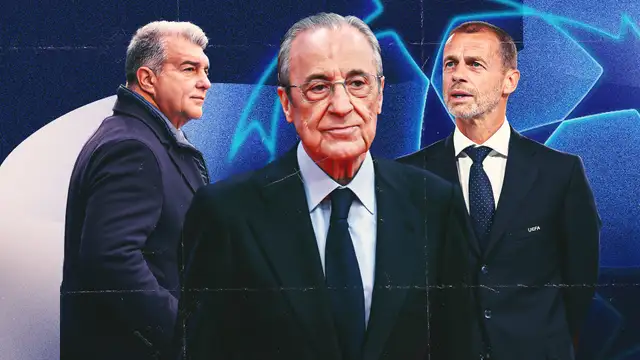

So, what exactly is going on at the highest level of the European game? How did a footballing civil war effectively break out across the continent? Is it now about to end? And if so, what would that mean for the Champions League going forward?
The constant Super League threat
Former UEFA chief executive Gerhard Aigner once dismissed the idea of a European Super League as "an illusion" – but its power has always been very real. As former AC Milan director Umberto Gandini pointed out, "the birth of the Champions League in 1993" was effectively UEFA's response to Silvio Berlusconi's attempt to create a breakaway competition for Europe's elite.
It was also no coincidence that in 1999, just two years after Berlusconi backed another bid to set up a Super League, UEFA increased the amount of teams and games in the Champions League, and introduced a second group stage to generate more matches.
As Josh Robinson of The Wall Street Journal previously told GOAL, "Any time the major clubs in Europe don't like the direction football is going in, the Super League is their go-to threat. It's a pretty handy tool for bending things in your favour."
Consequently, it wasn't remotely surprising to see talk of an ESL intensify in 2020, at a time when the financial fragility of European football's ridiculous business model was being brutally exposed by Coronavirus.
"Nothing will ever be the same again," long-time Super League supporter Perez stated at Madrid's Annual General Assembly. "The pandemic has changed everything. It has made us all more vulnerable, and football too."
Basically, in a period of arguably unprecedented uncertainty, Perez and many of his fellow presidents across the continent wanted financial guarantees - so they resurrected the ESL because, as financial expert Kieran Maguire told GOAL, "the real money in football is in European competition".
The birth of the ESL
The constant Super League threat
Former UEFA chief executive Gerhard Aigner once dismissed the idea of a European Super League as "an illusion" – but its power has always been very real. As former AC Milan director Umberto Gandini pointed out, "the birth of the Champions League in 1993" was effectively UEFA's response to Silvio Berlusconi's attempt to create a breakaway competition for Europe's elite.
It was also no coincidence that in 1999, just two years after Berlusconi backed another bid to set up a Super League, UEFA increased the amount of teams and games in the Champions League, and introduced a second group stage to generate more matches.
As Josh Robinson of The Wall Street Journal previously told GOAL, "Any time the major clubs in Europe don't like the direction football is going in, the Super League is their go-to threat. It's a pretty handy tool for bending things in your favour."
Consequently, it wasn't remotely surprising to see talk of an ESL intensify in 2020, at a time when the financial fragility of European football's ridiculous business model was being brutally exposed by Coronavirus.
"Nothing will ever be the same again," long-time Super League supporter Perez stated at Madrid's Annual General Assembly. "The pandemic has changed everything. It has made us all more vulnerable, and football too."
Basically, in a period of arguably unprecedented uncertainty, Perez and many of his fellow presidents across the continent wanted financial guarantees - so they resurrected the ESL because, as financial expert Kieran Maguire told GOAL, "the real money in football is in European competition".
The birth of the ESL
The combination of desperation and greed resulted in the horribly rushed foundation of a JP Morgan-backed European Super League on April 18, 2021.
"Twelve of Europe's leading football clubs have today come together to announce they have agreed to establish a new mid-week competition, the Super League, governed by its Founding Clubs," the press release read.
"AC Milan, Arsenal FC, Atletico de Madrid, Chelsea FC, FC Barcelona, FC Internazionale Milano, Juventus FC, Liverpool FC, Manchester City, Manchester United, Real Madrid CF and Tottenham Hotspur have all joined as Founding Clubs. It is anticipated that a further three clubs will join ahead of the inaugural season, which is intended to commence as soon as practicable.
"Going forward, the Founding Clubs look forward to holding discussions with UEFA and FIFA to work together in partnership to deliver the best outcomes for the new League and for football as a whole.
"The formation of the Super League comes at a time when the global pandemic has accelerated the instability in the existing European football economic model.
"Further, for a number of years, the Founding Clubs have had the objective of improving the quality and intensity of existing European competitions throughout each season, and of creating a format for top clubs and players to compete on a regular basis.
"The pandemic has shown that a strategic vision and a sustainable commercial approach are required to enhance value and support for the benefit of the entire European football pyramid.
"In recent months extensive dialogue has taken place with football stakeholders regarding the future format of European competitions. The Founding Clubs believe the solutions proposed following these talks do not solve fundamental issues, including the need to provide higher quality matches and additional financial resources for the overall football pyramid."
English clubs withdraw after bitter backlash
"Twelve of Europe's leading football clubs have today come together to announce they have agreed to establish a new mid-week competition, the Super League, governed by its Founding Clubs," the press release read.
"AC Milan, Arsenal FC, Atletico de Madrid, Chelsea FC, FC Barcelona, FC Internazionale Milano, Juventus FC, Liverpool FC, Manchester City, Manchester United, Real Madrid CF and Tottenham Hotspur have all joined as Founding Clubs. It is anticipated that a further three clubs will join ahead of the inaugural season, which is intended to commence as soon as practicable.
"Going forward, the Founding Clubs look forward to holding discussions with UEFA and FIFA to work together in partnership to deliver the best outcomes for the new League and for football as a whole.
"The formation of the Super League comes at a time when the global pandemic has accelerated the instability in the existing European football economic model.
"Further, for a number of years, the Founding Clubs have had the objective of improving the quality and intensity of existing European competitions throughout each season, and of creating a format for top clubs and players to compete on a regular basis.
"The pandemic has shown that a strategic vision and a sustainable commercial approach are required to enhance value and support for the benefit of the entire European football pyramid.
"In recent months extensive dialogue has taken place with football stakeholders regarding the future format of European competitions. The Founding Clubs believe the solutions proposed following these talks do not solve fundamental issues, including the need to provide higher quality matches and additional financial resources for the overall football pyramid."
English clubs withdraw after bitter backlash
The ESL's original format was inspired by basketball's EuroLeague, which came as no surprise, as it was a tournament in which Perez's Real Madrid competed and one he had referenced on several occasions while championing a new continental competition.
Essentially, the new tournament would feature 20 teams in total (15 permanent members and five annual qualifiers based on domestic results) and they would compete against one another in two groups of 10 to reach a knockout stage that would determine the overall winner.
However, the fact that Bayern Munich, Borussia Dortmund and Paris Saint-Germain all declined invites did not bode well at all and the bitter backlash, from fans, players and local football associations to what was effectively a 'closed shop', resulted in all six of the English clubs pulling out of the project within three days of its official unveiling.