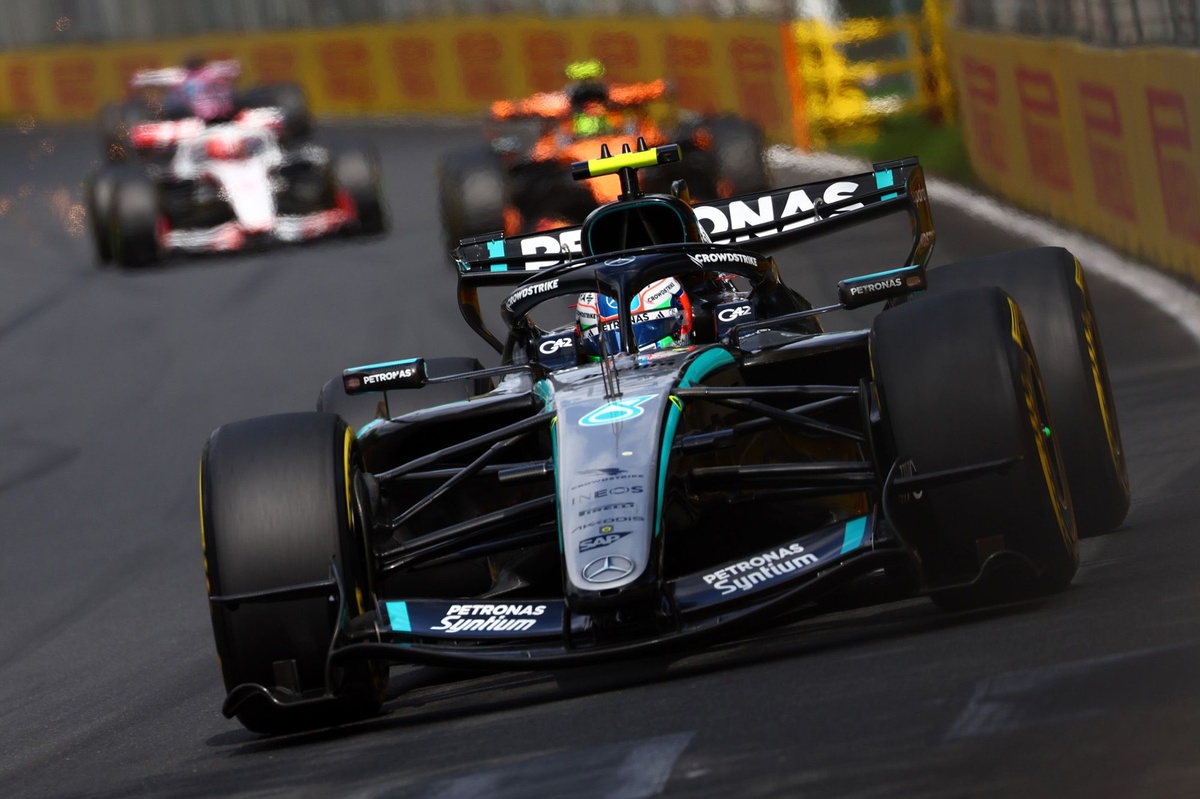

The Australian Grand Prix wasn't just a race; it was a thunderous declaration from Mercedes, signaling a potential shift in the Formula 1 pecking order that has left even their own engine customers stunned. While George Russell's victory officially marked their triumph, the true tale lay beneath the surface: Mercedes' unparalleled mastery of energy deployment.
Key Takeaways from Albert Park:
- Mercedes showcased unexpected, dominant pace at Albert Park, especially in energy management.
- George Russell's victory highlighted the team's ability to maintain speed through corners and on straights without compromise.
- Customer teams like McLaren and Williams expressed surprise at the significant performance gap, despite using Mercedes power units.
- The mystery lies in Mercedes' superior understanding and deployment of their engine's energy capabilities, a key differentiator in the new F1 era.
Mercedes Unleashed: A Masterclass in Efficiency
The season opener in Melbourne saw Mercedes silence skeptics, not just by winning but by demonstrating a fundamental advantage. Despite Toto Wolff's initial claims of a continued "fight" with Ferrari, the Silver Arrows quickly proved to be in a league of their own. Russell's ability to set faster lap times on older tires, even after Ferrari's pit stop, underscored their inherent pace.
The current F1 regulations often create a "yo-yo" effect in racing, where overtaking leads to immediate counter-attacks due to energy management complexities. Lando Norris called the racing "even worse" than qualifying, labeling it "way too artificial." However, once Mercedes found clean air, their true superiority in breaking free from this dynamic became glaringly obvious.
The Energy Deployment Enigma
At the heart of Mercedes' dominance is their remarkably efficient energy deployment system. GPS data from qualifying, comparing Russell's pole lap to Oscar Piastri's fastest McLaren effort, revealed a fascinating truth: Mercedes was quicker in nearly every corner. Traditionally, such cornering speed would demand a compromise on the straights, sacrificing top-end pace for mechanical grip.
Yet, this wasn't the case for Mercedes. Russell stayed flat out longer towards Turn 6, which should typically reduce energy harvesting. But astonishingly, the delta time increased on the following straight towards Turn 9, with Piastri resorting to "super clipping" much earlier. This indicated Mercedes' unparalleled ability to regenerate and deploy energy, effectively gaining time where rivals expected them to lose it.
Customer Confusion: McLaren and Williams Speak Out
The revelation left Mercedes' customer teams scratching their heads. McLaren Team Principal Andrea Stella admitted his team has "work to do" with their HPP engineers, suggesting "low-hanging fruit" they should be able to "cash in." He hinted at a "journey of knowledge" that the works team has embarked on much earlier, potentially due to different engine specifications provided during Bahrain testing for the new 2026 units.
Williams Team Principal James Vowles, a former Mercedes strategist, was equally taken aback. He stated that what Mercedes is doing with their power unit "caught us off guard," estimating a three-tenths difference. While Vowles firmly believes Mercedes is "incredibly fair" and customer teams have access to the same hardware, he acknowledged the "shocking" extent of the works team's "cleverness."
The Works Team Advantage: A Double-Edged Sword?
This disparity highlights a crucial, albeit logical, disadvantage for customer teams, especially during significant regulation changes. While they receive the cutting-edge power unit, the deep, nuanced understanding of how to extract maximum performance and optimize energy deployment remains a proprietary advantage for the works team. It's not about hardware access, but the intricate software and operational know-how.
McLaren CEO Zak Brown reiterated his satisfaction with HPP, pointing to past championship wins. However, he acknowledged the "downside of not getting it right" if pursuing an independent engine project like Red Bull. For now, customer teams rely on Mercedes to provide a competitive, if not fully optimized, package.
Toto Wolff defended Mercedes' position, citing the steep learning curve of new regulations and the difficulty of "deploy[ing] things to make everybody happy." Ultimately, after years of occasionally being outshone by customer teams, Mercedes is back in the driver's seat, enjoying the benefits of their innovation and deep technical understanding. The Melbourne win wasn't just a race victory; it was a powerful statement about their technological superiority.