
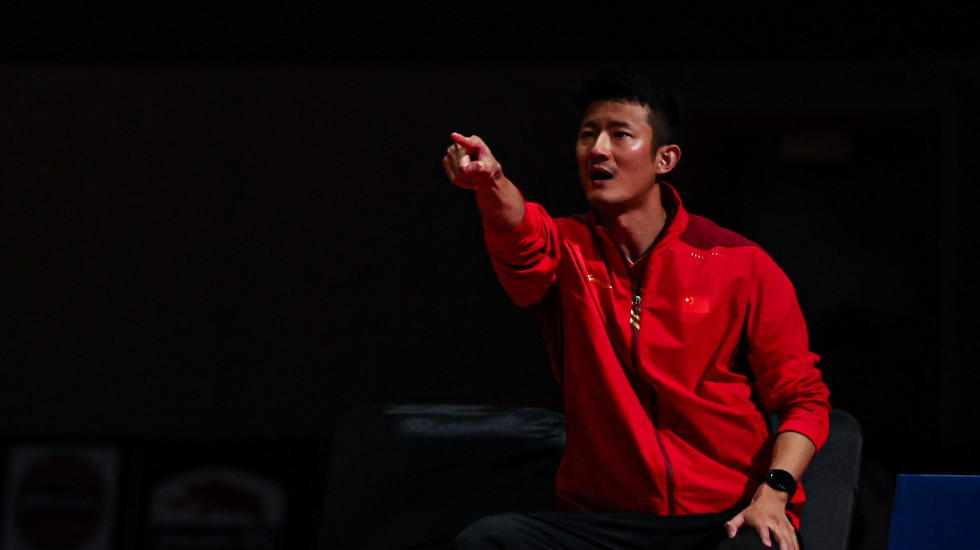

One thing hasn’t changed, though – and that’s his relationship with success.
In his first major campaign with the junior team, Chen – in charge of men’s singles — oversaw a superlative performance by his players at the YONEX SUNRISE BWF World Junior Championships 2025.
The team surmounted all the challenges that came their way both at the team and individual championships – winning the Suhandinata Cup mixed team event, and following that, picking up three individual titles. It couldn’t have gone any better for China, given that the championships saw the introduction of new scoring formats at both events.
Chen himself hadn’t been too concerned about the effect the scoring system would have on his team’s chances. He saw it as a new test for his players; once the championships were over, his faith was vindicated.
The team surmounted all the challenges that came their way both at the team and individual championships – winning the Suhandinata Cup mixed team event, and following that, picking up three individual titles. It couldn’t have gone any better for China, given that the championships saw the introduction of new scoring formats at both events.
Chen himself hadn’t been too concerned about the effect the scoring system would have on his team’s chances. He saw it as a new test for his players; once the championships were over, his faith was vindicated.
The 2016 Olympic champion speaks on the innovations in scoring, his transition to coaching, and the contrasts between his earlier career and current one:
Your thoughts on the scoring systems used at the World Juniors?
The new scoring system helps narrow the gap between teams, making matches more competitive. It requires greater speed and demands full commitment from the very start. Since each team faces the same challenge under the new system, we’re all going through a learning process. I think it’s a good thing for young athletes to try more and gain different experiences.
Were you initially concerned that other teams would close the gap with China?
Firstly, I want to say that I’m not concerned at all. For the global development of badminton, it’s essential that the competitive level improves across all the teams. This is key to enhancing sport’s overall influence and popularity. Therefore, I consider it a positive development when more teams can compete closely with Team China, as it ultimately serves as a strong motivation for our own players to strive for improvement.
Speaking of your transition to coaching, did you undergo any formal course to train as coach?
Currently, we don’t have a course for this. It (system) primarily relies on learning through practical experience after the athlete’s transition into coaching. Additionally, we engage closely with our excellent coaching team, learning from them through meetings and performance reviews.
As for the question about whether we’ve taken any formal coaching courses, the transition to coaching a youth team is a continuous learning process. Therefore, my focus remains on performing well in my current role.
Even before officially assuming the coaching role, I was already working with the Chinese national badminton team in their preparations for the Paris Olympics, both in terms of learning and assisting the players. I was also involved in the Sudirman Cup in 2023 and the Thomas & Uber Cup in 2024. All of this really helped build a foundation for me as a coach.
What’s the biggest difference you experience as a coach in contrast to being a player?
When I was a player, I usually had a good read on whether I could win or lose. The pressure now as a coach isn’t as heavy as when I was an athlete. However, the uncertainty surrounding the match and how our athletes will perform does leave me feeling somewhat less assured. Still, it’s a job I really love, and I’m quite happy with it.
For sure it is stressful as a coach. For example, you saw the men’s singles semifinals was quite stressful. I don’t need to play on court but I was feeling the same stress as the player – perhaps even more!
You were quite impassive as a player, but as coach you are quite animated…
As a player I needed to be poker faced to make my opponent wary of me, and to focus better, but as a coach, I’m trying to make my players feel better. I will cheer them up when they play a good point, and if they lose, I have to tell them that it’s OK, and I have to help them out.
I feel very good I helped my player win through my coaching; for the future I think I will continue to work with the juniors and will continue step by step.
As a coach, what are the indispensable qualities you look for in players?
I believe the foundation is a genuine love for badminton. Along with that passion, you must have unwavering self-belief and mental toughness. The path of growth is inevitably filled with setbacks. Without a resilient mind, you might plateau or even regress when facing these challenges. Therefore, a strong mentality is essential for progress and development, and it must be supported by relentless hard work in daily training.
In terms of match preparation, how different is it as coach compared to being a player?
I’d say being a coach requires considering things from more dimensions than being an athlete. Athletes can primarily focus on their own performance and training. A coach, however, has to manage a whole team — maybe 10, eight, or even more players. So naturally, there are simply more aspects to think about.
What do you make of the challenges to the current generation of players compared to your generation?
I think the young athletes of today are truly fortunate. Our nation’s growing strength has led to vastly improved support systems. Because of this, they now enjoy training conditions, facilities, gear, and technological resources that are far superior to what we had.
Perhaps one of the biggest challenges to teenagers is addiction to devices and their effect on focus. Do you face these issues as a coach?
Times are changing. Coaches can’t provide 24/7 supervision, so it’s more about reasoning with the athletes. For now, that means managing their screen time. Also, they should minimize posting on their personal social media accounts as much as possible during our intensive training camps.
Are you concerned about social media’s effects on young players?
I believe that currently, this doesn’t really affect the players. Of course, the public reaction can vary from country to country. When you perform well, fans and netizens praise you. But after a poor performance, there’s often criticism and negativity. Ultimately, I believe it comes down to the individual. Coaches can advise them, but ultimately, they need to come to terms with it on their own.