
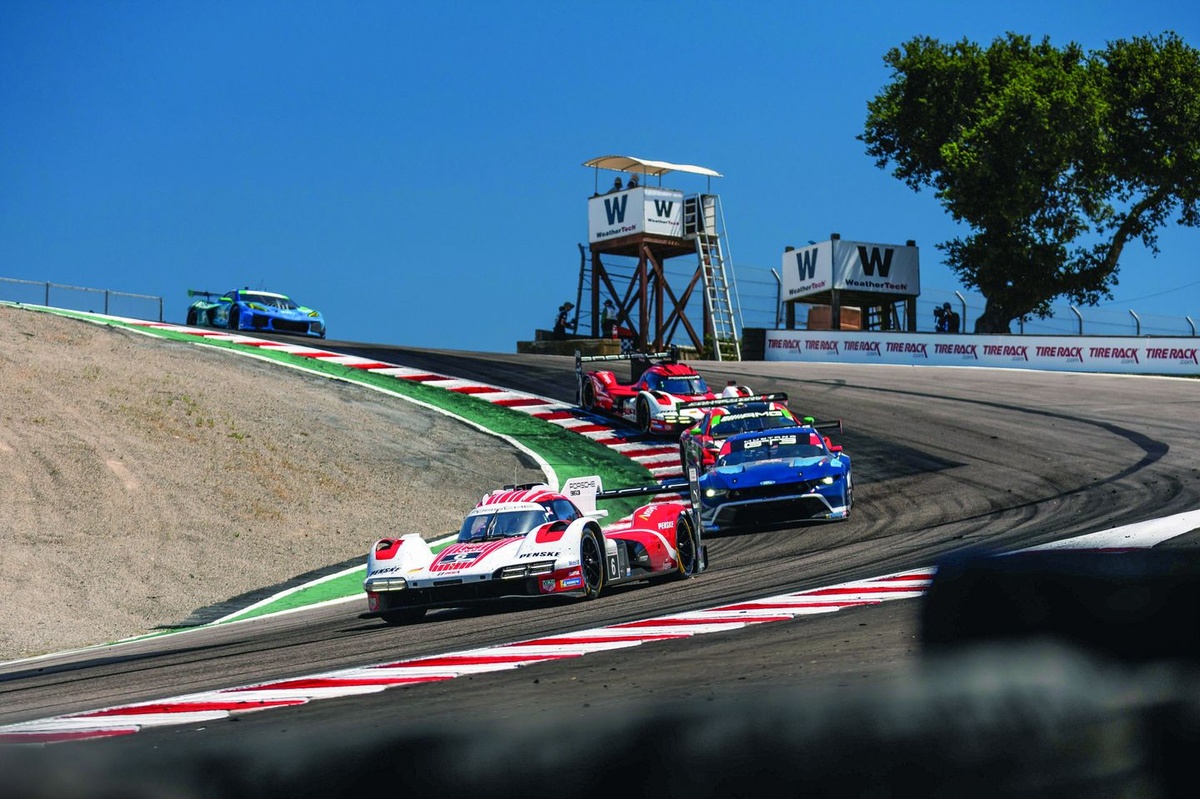

Following the WEC's lead, IMSA imposes strict rules on BoP-related comments by drivers, teams and manufacturers whilst releasing the BoP for the 64th Daytona 24 Hours.
Mirroring the World Endurance Championship (WEC), IMSA has introduced stricter communication rules concerning the Balance of Performance (BoP). Critical remarks from participants can now lead to significant penalties.
The new Article 2.2.3. (“Conduct and Communications”) in the Sporting Regulations now states: “Manufacturers, Competitors, Drivers, Constructors, and any persons or entities associated with their entries must not attempt to influence the establishment of the Balance of Performance (BoP) or make any public comments regarding the BoP process, methodology, data, or outcomes, including but not limited to statements made through traditional media, digital media, or social media platforms.
i. The determination of whether any conduct or communication constitutes a violation of the above, regardless of intent, shall be made exclusively at IMSA’s sole discretion.
ii. Any infringement may be penalized by IMSA Officials at any time before, during, or after an IMSA Competition.”
In general, the BoP plays a less significant role in IMSA compared to the WEC.
Due to frequent Full Course Yellows, the outcome of the race often depends on who has the best tyres for the final sprint, gains track position during pit stops under yellow, or shows the most determination after the final restart.
Nevertheless, the BoP remains a crucial part. Like the WEC, IMSA utilises a two-stage BoP, although it works a little differently: Instead of a fixed threshold at 250 kph (WEC), IMSA uses a transition zone between 230kph and240 kph, where the power adjusts to its new level in linear progression. This system was introduced in 2025.
Daytona is the fastest track on the calendar, making both power ranges equally important. Furthermore, the performance above 240 kph is decisive for overtaking opportunities.
The primary indicator for vehicle performance is the power-to-weight ratio. Establishing the 2026 BoP was particularly challenging, as the four LMDh cars received significant updates.
A test at Daytona International Speedway in November provided IMSA technicians with initial benchmarks alongside simulation data.
IMSA’s current BoP table refers to both the "Roar before the 24" and the race itself. In previous years, an additional update was usually released after the Roar. However, a final adjustment before the race cannot be entirely ruled out.
Acura, BMW, and Aston Martin are very closely matched in the lower range. Cadillac sets the benchmark with the best ratio, while Porsche falls slightly behind.
Compared to last year's WEC and Daytona 2025 BoPs, when the Cadillac was well above 2.1 kg/kW, the current gaps are narrow.
Porsche regains its momentum lost in the low-speed range in the high-speed sectors with a power-to-weight ratio below 2.0.
The Aston Martin enjoys the best BoP here, which doesn’t come as a surprise, as the Le Mans 24 Hours already demonstrated that the V12-powered Hypercar is draggy and relies on a favorable top-end BoP.
Compared to last year, some data have changed significantly. However, a direct comparison is difficult because the updates to the cars are extensive and, in all four cases, include aerodynamic modifications. Therefore, these figures should be interpreted with caution.
The Aston Martin Valkyrie did not compete in the 2025 24 Hours of Daytona and is therefore not included in this comparison.
The BMW M Hybrid V8 seems to have received the least favorable adjustment as it is featuring the most extensive updates with a roughly 50% new bodywork. It appears IMSA wants to avoid the risk of the revamped car immediately outclassing the field.
Conversely, the Cadillac BoP might seem surprising, as the V-Series.R has also received a major update, most notably the spectacular low rear wing.
However, it shouldn’t be forgotten that Cadillac was struggling with its 2025 Daytona BoP. The fastest lap of a V-Series.R was 0.581 seconds slower than the overall fastest lap of the race. This was largely due to a very high base weight of 1,060 kg, which has now been reduced significantly.
A look at the maximum stint energy shows a reduction for most GTP cars. The Cadillac stands out here particularly, despite receiving the largest power increase in the below 230 kph range.
The Porsche 963 as the only exception is allowed to carry more energy—likely to compensate for the nearly 10 kW power increase in the upper speed range.
So the organisers are playing it safe whilst incorporating lessons learned from last year. Due to the extensive updates, the BoP still remains something of a "shot in the dark."
(Numbers in parentheses = Change from previous year)
Acura ARX-06
Aston Martin Valkyrie
BMW M Hybrid V8
Cadillac V-Series.R
Porsche 963
What would you like to see on Motorsport.com?
- The Motorsport.com Team


