
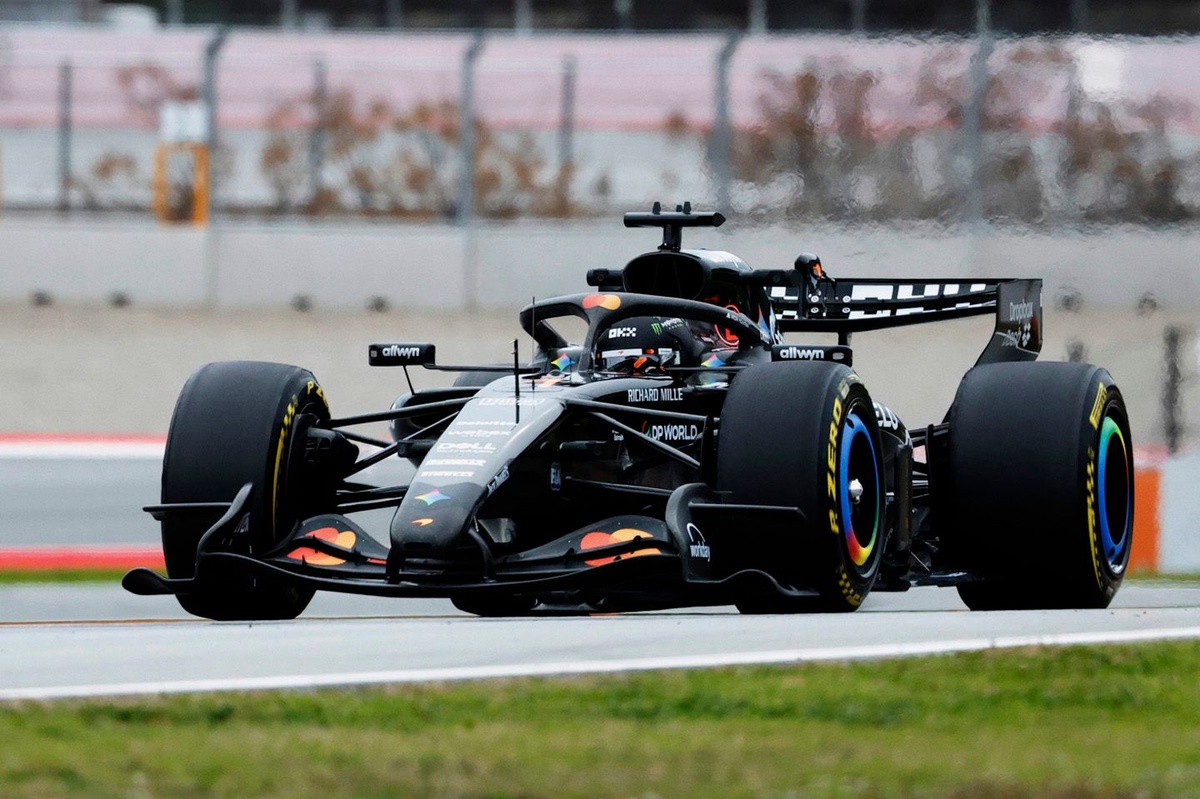

The whispers around the paddock have exploded into a full-blown debate: are the revolutionary 2026 Formula 1 cars a step forward, or are they feeling a little too much like their junior counterparts?
This isn’t just idle chatter. Top drivers like Lando Norris are weighing in, creating a buzz that has the entire racing world questioning the implications of the upcoming regulation changes.
Norris's First Impressions: A Familiar Feel?
Lando Norris, fresh from testing his new McLaren MCL40 in Barcelona, has dropped a bombshell. The 2026 F1 cars feel "more like an F2 car in some ways with how you have to drive it." This isn’t about outright speed, but the fundamental feel and driving characteristics that demand a different approach.
The 2018 F2 runner-up admitted he’s still evaluating whether this altered dynamic is a positive. He highlighted that the wide, open corners of Barcelona might not fully reveal the cars' true character compared to tighter street circuits or bumpier tracks. The real answers, he believes, will emerge at the Bahrain tests.
The Driver Consensus: Nimble, Yet Different
It’s not just Norris sounding the alarm. Back at last year’s Las Vegas Grand Prix, Aston Martin reserve driver Jak Crawford noted a "quite similar" feel to an F2 car in simulator sessions. Isack Hadjar echoed this, suggesting they were "closer to an F2 car performance-wise," shifting the conversation slightly toward pace.
More recently, drivers like Esteban Ocon, Oliver Bearman, and Oscar Piastri have described the new machinery as "more nimble." Gabriel Bortoleto also drew the F2 parallel, specifically noting the powerful 50% electric hybrid boost out of corners, demanding a new adaptation from drivers. These insights reveal a growing consensus: the driving experience is clearly changing.
FIA Pushes Back: Debunking the Performance Myth
The FIA, through its single-seater director Nikolas Tombazis, has been quick to quash any notion that the 2026 F1 cars will truly perform at F2 levels. "Comments about Formula 2 pace are way off the mark," Tombazis asserted, emphasizing a clear distinction between the perceived driving feel and outright speed.
He clarified that while initial lap times might be 1–2 seconds slower than current F1 benchmarks, this is a natural part of a new regulation cycle. The intention is not to start faster, allowing for gradual development throughout the era.
The goal remains unmistakably Formula 1 performance and excitement.
The Cold Hard Numbers Don't Lie
To underline the FIA’s point, unofficial times from the Barcelona shakedown saw Lewis Hamilton clocking around 1m16.348s in his Ferrari. Compare that to last year’s F2 pole position of 1m25.180s, set by Arvid Lindblad, and the gap is a substantial 9 seconds.
This stark difference proves that while the driving characteristics might evoke an F2 comparison for some drivers, the raw speed and power output of the new F1 machines remain in a league of their own.
The adaptation for drivers will be in mastering the unique blend of a lighter chassis, active aero, and the potent 50% electric power unit that defines the 2026 Formula 1 era.


